
Botanical.com Home Page
HoneysucklesBotanical: Lonicera caprifolium (LINN.), Lonicera Periclymenum (LINN.)
---Synonyms---Dutch Honeysuckle. Goats' Leaf.
|
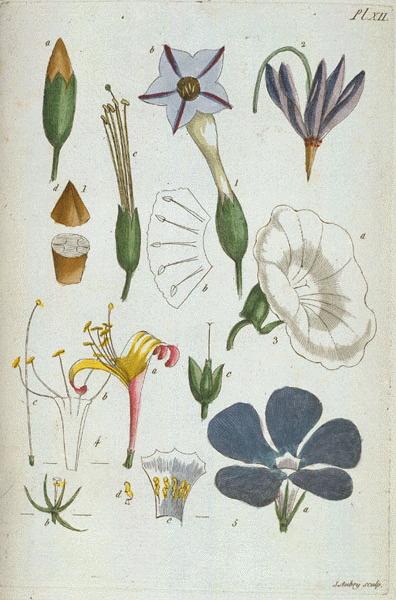
|
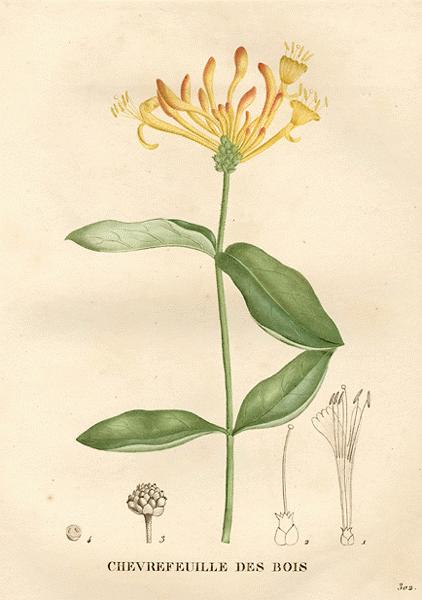
(Lonicera periclymenum LINN.) Click on graphic for larger image |
---Medicinal Action and Uses---A dozen or more of the 100 species of Lonicera or Honeysuckle are used medicinally, the fruits generally having emiticocathartic properties. Several of these drugs have more than a local repute.
The herbage of L. caprifolium (Linn.), the smaller, or ITALIAN HONEYSUCKLE, of Mid- and Southern Europe, is used as a cutaneous and mucous tonic and vulnerary and the seeds as a diuretic.
L. Periclymenum (Linn.), our common ENGLISH WILD HONEYSUCKLE, is used similarly and the stems as a substitute or adulterant for Solanum Dulcamara, the Bittersweet.
- Waller says: 'The leaves and flowers of Honeysuckle are possessed of diuretic and sudorific properties,' and adds:
- 'a decoction of the flowers has been celebrated as an excellent antispasmodic and recommended in asthma of the nervous kind. An elegant water may be distilled from these flowers, which has been recommended for nervous headache.'
- Gerard says: 'The Honeysuckle is "neither cold nor binding, but hot and attenuating or making thin." ' He quotes Dioscorides as saying that:
- 'the ripe seed gathered and dried in theshadow and drunk for four days together, doth waste and consume away the hardness of the spleen and removeth wearisomeness, helpeth the shortness and difficulty of breathing, cureth the hicket (hiccough), etc. A syrup made of the flowers is good to be drunk against diseases of the lungs and spleen.'
Salmon in his Herbal (1710) speaks only of the Meadow Honeysuckle, 'which was the name given by the agriculturists of his day to the Meadow Trefoil (Trifolium pratense).'
The herbage of the true Honeysuckles is a favourite food of goats, hence the Latin name Caprifolium (Goats' Leaf), the French Chèvre-feuille, German Geisblatt and Italian Capri-foglio, all signifying the same. The berries have been used as food for chickens. The name of the genus, Lonicera, was given by Linnaeus in honour of Adam Lonicer, a physician and naturalist, born at Marburg in 1528, who wrote, among other works, the Naturalis Historiae Opus novum, which contains much curious information about plants.
Our native Honeysuckle has expectorant and laxative properties. The flowers in the form of syrup have been used for diseases of the respiratory organs and in asthma and the leaves as decoction in diseases of the liver and spleen. It was also considered a good ingredient in gargles.
L. tartarica, a native of Siberia, an upright species, a shrub, not a climber, has berries which are nauseously bitter and purgative.
The wood of L. Xylosteum, native of Eastern Europe and Asia, but found naturalized in Sussex, also of shrub-like nature, is used by the Russians to prepare an empyrheumatic oil for 'cold tumours and chronic pains. ' It is sold in China as Jin-tung. Animals seldom touch the leaves of this species and birds eat its berries only in hard weather - they are reputed to be purgative and emetic.
L. brachypoda repens is used in Japan as a drastic purgative, and L. Japonica (Thunb.) is sold in China as Kin-yin-keva.
Diervilla, the Bush Honeysuckle, especially Diervilla Diervilla (L. Diervilla, Linn.), has a similar repute, especially as a diuretic and as an application to relieve itching.
Various species of Symphoricarpus, Snowberry, Wax-berry, Coral-berry, Indian Currant, Turkey-berry, Wolf-berry, to give a few of its names, of North America, are similarly employed. S. racemosa (Mich.) is often planted in hedges.
- Culpepper says:
- 'Honeysuckles are cleansing, consuming and digesting, and therefore no way fit for inflammations. Take a leaf and chew it in your mouth and you will quickly find it likelier to cause a sore mouth and throat than cure it. If it be not good for this, what is it good for? It is good for something, for God and nature made nothing in vain. It is a herb of Mercury, and appropriated to the lungs; the celestial Crab claims dominion over it, neither is it a foe to the Lion; if the lungs be afflicted by Jupiter, this is your cure. It is fitting a conserve made of the flowers should be kept in every gentlewoman's house; I know no better cure for the asthma than this besides it takes away the evil of the spleen: provokes urine, procures speedy delivery of women in travail, relieves cramps, convulsions, and palsies, and whatsoever griefs come of cold or obstructed perspiration; if you make use of it as an ointment, it will clear the skin of morphew, freckles, and sunburnings, or whatever else discolours it, and then the maids will love it. Authors say, the flowers are of more effect than the leaves, and that is true: but they say the seeds are the least effectual of all. But there is a vital spirit in every seed to beget its like; there is a greater heat in the seed than any other part of the plant; and heat is the mother of action.'
A
-
B
-
C
-
D
-
E
-
F
-
G
-
H
-
I
-
J
-
K
-
L
-
M
N
-
O
-
P
-
Q
-
R
-
S
-
T
-
U
-
V
-
W
-
Y
-
Z
© Copyright Protected 1995- Botanical.com